

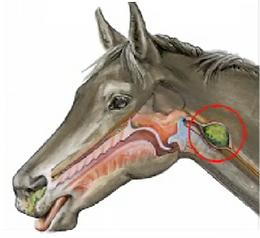
An esophageal obstruction, or choke, is a common emergency in horses. This emergency occurs when food or a foreign object blocks the muscular tube from mouth to stomach. This emergency can be caused by the quick ingestion of feed, improper chewing due to dental disease, inadequate water intake, ingestion of a foreign body, or the presence of disease of the esophagus.
Horses that are choking tend to stretch out their neck, show signs of distress, or have feed coming out of one or both nostrils. Occasionally horses that are choked will resolve the choke themselves. If you suspect your horse may be choking, remove feed and water immediately, keep the horse calm and encourage them to keep their head down to allow gravity to help resolve the choke. If the horse is unable to resolve the choke, a veterinarian needs to be called to help. The longer the horse is choked for, the higher risk of complications.
Treatment of the choke involves sedation, removal of the choke, and management of any complications. Sedation and muscle relaxers allow the esophagus to relax. Water is lavaged through a nasogastric tube to break up the impaction. The nasogastric tube is passed into the stomach to confirm complete resolution of the impaction. If the horse has been choked for a long time or the choke was difficult to resolve, the esophagus may need to be visualized with an endoscope to assess the damage. The horse may need to be started on antibiotics due to concerns about aspiration pneumonia. Aspiration pneumonia can occur when feed material ends up in the trachea, this is a common complication with difficult chokes.
After the choke is resolved, steps should be taken to find the cause. Choke can be prevented by the following
- Make sure treats are portioned properly and feed is soaked thoroughly
- Ensure water is always available, consider using tank heaters in the winter and visualizing their water source every day
- Using hay nets or spreading out feed to keep horses from bolting their hay
- Using flow feeder toys or buckets to prevent horses from bolting their grain
- Providing many piles of feed in herd situations so horses lower in the herd don’t feel pressured to quickly eat their feed
- Have your horses’ teeth examined yearly to identify dental issues as oral pain can often be a precipitating factor that leads to esophageal choke