

Autologous stem cells, Platelet Rich Plasma, IRAP, ProStride, Alpha 2 Macroglobulin, and Bone Marrow aspirates- therapies to help your equine athlete recover from their orthopedic injuries
Equine tendon, ligament, and joint injuries are some of the most frequently seen problems in clinical veterinary practice leading to joint instability, soft tissue injuries and/or degenerative joint disease, and reduced performance. Osteoarthritis also known as degenerative joint disease (DJD) is one of the main causes of lameness in horses. Osteoarthritis occurs when the cartilage surrounding the joints deteriorates or is destroyed leading to pain and inflammation. Areas that are affected the most are knee, hock, fetlock, pastern and coffin joints.
Many horse owners us oral supplements (MyristolTM and Platinum performance-CFTM) that contain glucosamine, chondrotin sulfate, MSM, acetyl Myristolate and/or avocado extract are also commonly administered.
Conventional joint therapies have involved intra-articular medications such as hyaluronic acid, Noltrex and/or corticosteroids, rest, NSAIDS (bute, banamineTM, SurpassTM, EquioxxTM), focused shockwave therapy, polysulfated glycosaminoglycans (PSGAG such as Adequan) and intravenous hyaluronic acid (Legend).
Alpine Equine hospital offers the latest regeneartive modalities to help get your equine athlete get back in the show pen. Here are some of the options we offer:
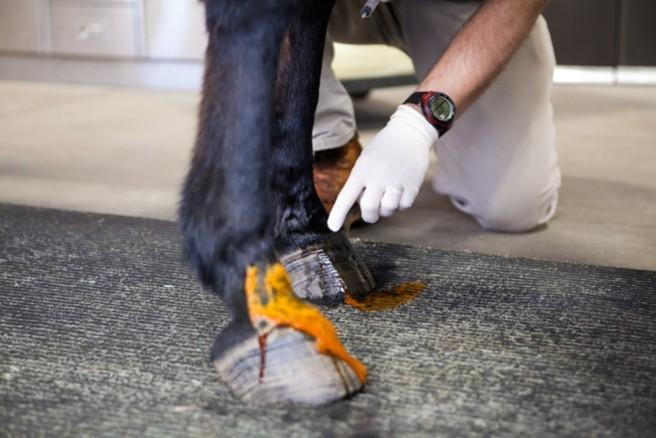
Adult derived stem cells are an effective means of treating certain acute and chronic tendon injuries, suspensory and collateral ligament injuries and osteoarthritis in our horse patients. Cells obtained are concentrated and autologous to the patients in which they are used. Stem cells offer regeneration of injured tissues that can result in a higher likelihood of return to their previous level of performance. The process begins with the harvesting of 20-30 cc or bone marrow aspirate from the sternum or point of the hip Bone marrow aspirate under routine sedation ( see picture above). This aspirate is then shipped overnight to Advanced regenerative technologies in Fort Collins where the cells are filtered and expanded or processed into millions of pleuripotential stem cells in approximately 3 weeks. These stem cells are then packaged for injection and sent back to Alpine Equine for ultrasound guided injection into the damaged ligament or tendon and in some cases joints. Subsequent stem cell treatments if deemed necessary can be performed without any additional surgical procedures using expanded stem cells stored from the original sample.
PRP stands for Platelet Rich Plasma, or blood plasma with concentrated platelet content. Platelets are derived from stem cells in the patient’s bone marrow and are among the first cells to arrive at an injured tissue. As platelets come into contact with the damaged collagen and endothelial cells, a fibrin clot forms and growth factors are recruited and released augmenting the healing response. Two growth factors are of particular interest in dealing with orthopedic injuries. Growth factor beta and platelet derived growth PRP processing factor are released upon activation at an injured site. These growth factors and others act synergistically to enhance access of healthy inflammatory cells to the area of tissue injury, formation of new blood vessels (angiogenesis), formation of new connective tissue (fibroplasia) and regeneration of skin (re-epithelialization). Many times PRP is used in conjunction with adult derived stem cells.
Injection of PRP is a recommended treatment option in certain types of sub-acute and chronic joint, tendon and ligament injuries. The procedure is done in the standing horse under sedation and a local nerve block. Whole blood is obtained from the horse in a special syringe, and once processed, the PRP is directed at the injured site. The limb is bandaged for several days. The horse returns to a controlled exercise protocol based on subsequent ultrasound findings and degree of lameness at a follow-up period based on the original injury. Re-examination with ultrasonography is typically conducted every 30-60 days over the first four months, then every 60 to 90 days during the remaining healing period.
Treatment with Interleukin-1 Receptor Antagonist Protein (of IRAP) also harnesses progressive gene therapy to combat osteoarthritis in your horse. Like all these orthobiologics, it has also been used in people, dogs and cats. Interleukin-1 (IL-1) is a cytokine, a messenger protein, that is secreted by many types of cells. Cytokines are proteins secreted by the cells of the immune system to signal and direct the attack of infected, damaged or dying cells. Many new treatments for human diseases are centered around managing the cytokine response to disease. While IL-1 is an important part of the inflammatory response, it can can be detrimental in osteoarthritic patients with its effects on the inflammatory cascade heaving the effect to accelerate the deterioration of tissues like joint cartilage. Interleukin-1 Receptor Antagonist Protein (or IRAP) blocks IL-1 from binding to tissues and inhibits the damaging consequences of IL-1. IRAP syringe
The IRAP process begins with drawing 60 cc of blood from the horse into a special syringe. The syringe is specially prepared with glass beads that stimulate production of the antagonist protein (Il-1a) and an anticoagulant. The process of harvesting, incubating and centrifuging the blood to separate the plasma (abundant with IRAP) from the blood takes 24 hrs. Typically, IRAP treatments are every 10 days for three treatments.
Treatment with ProStride also harnesses progressive gene therapy to combat osteoarthritis in your horse. Like all these orthobiologics, it has also been used in people, dogs and cats. Unlike IRAP, it harness the power of white blood cells, platelets and over 20 beneficial cytokines to down regulate inflammation and promote healing.
The Prostride process begins with drawing 60 cc of blood from the horse into a special syringe. The process of harvesting, and centrifuging the blood to separate the plasma from red blood cells can be done patient side in 17 minutes adding additional benefits without the 24 hour incubation time of IRAP.
The last Orthobiologics used at Alpine Equine is Alpha-2-macroglobulin (α2M) or Alpha2Eq. Alpha 2 M Eq is protein derived from the patient’s own plasma used to scavenge unwanted inflammatory biproducts and promote healing. When trauma occurs to joints and soft tissue, it triggers the inflammatory cascade. This casacade includes the release of protease enzymes, and pro-inflammatory cytokines. Left unchecked these proteases and cytokines further advance tissue damage.  A2M processing
Alpha-2-macroglobulin (α2M) is a naturally occurring large protein within the blood. The molecule has unique ability to block the destructive effect of these inflammatory enzymes by capturing or trapping them stopping them from having their unwanted effects. α2M has a unique multimodal mechanism of action in that it is a non-specific protease inhibition that favorably affects gene regulation, as well as cytokine and growth factor modulation. This modality is also showing promise in difficult corneal infections and when used via regional limb perfusion in acute laminitis cases.
Finally, we are also bone marrow aspirates to harness the regenerative benefits of stems cells found in your horse's bone marrow to help rehabilitate horses with orthopedic injuries. Alpine utilizes the CenTrate® BMA device to obtain regenerative cells from the horse’s own bone marrow to help initiate the healing process of cartilaginous lesions, boney defects and tendon injuries. CenTrate BMA is primarily used in helping manage moderate to severe chronic osteoarthritis and soft tissue injuries.1 It is also often used after surgery to facilitate recovery. The concentrated bone marrow aspirate is often combined with platelet rich plasma and is introduced to the injury site where the cells provide the key initiation of the healing process based on the environment they’re placed in.
Orthobiologics are a state of the art steroid-free alternatives that can help ensure a better recovery from the types of injuries we see in our equine athletes These novel regenerative treatment options allow us to approach and better combat orthopedic injuries and osteoarthritis in your horses. These approaches are exciting in part due to their potential long-term effect on battling osteoarthritis. Stem cells, platelet rich plasma and IRAP attack the inflammatory processes and assist healing in new ways not offered with conventional therapies.
Though the research in this field is ongoing and the results have been very encouraging. Please give us a call if you have questions or wish to discuss how we can ensure your horse's optimal recovery.